How much does an interview videographer cost in London?
The short answer is: it depends on what you need.
A simple interview filmed and edited in a single location can cost considerably less than a fully produced corporate film with multiple cameras, professional lighting, detailed editing and additional B-roll.
As we head into 2027, London businesses have more options than ever when it comes to video production. But that can make comparing quotes confusing. Two videographers can quote very different prices for what initially appears to be the same project.
The reason is that you’re not necessarily comparing the same thing.
In this guide, we’ll look at what you can expect to pay for an interview video in London, what affects the cost, what’s usually included, and how to work out what level of production is right for your business.
There isn’t one standard price for an interview videographer in London.
As a general guide, professional interview video projects can range from around £1,000 for a relatively straightforward production to several thousand pounds for a more involved corporate or cinematic project.
For example, you might encounter:
| Type of production | Indicative budget |
|---|---|
| Simple interview filming | £500–£1,000+ |
| Interview filming + professional edit | £1,000–£1,750+ |
| Corporate interview production | £1,500–£2,500+ |
| Cinematic interview or case study | £2,000–£4,000+ |
| Larger multi-interview production | £3,000–£5,000+ |
These figures are indicative market ranges, not fixed prices. Actual quotes will vary depending on the videographer, location, filming requirements, post-production and final deliverables.
A £1,000 project and a £3,000 project may both be described as an “interview video”, but they can involve very different levels of production.
That’s why the most useful question isn’t simply:
How much does an interview videographer cost?
It’s:
What am I getting for that price, and will it achieve what I need?
What affects the cost of an interview video?
There are several factors that can move the price of an interview production up or down.
Understanding them will make it much easier to compare quotes.
1. The amount of filming time
One of the simplest factors is how long you need the videographer and crew on location.
A short interview with one person in one location is relatively straightforward.
A production involving several interviewees, multiple locations and additional B-roll could require considerably more time.
You may need:
- A few hours of filming
- A half day
- A full day
- Multiple filming days
It’s worth remembering that the filming time isn’t the only time involved.
There can also be preparation before the shoot and several hours, or days of work afterwards.
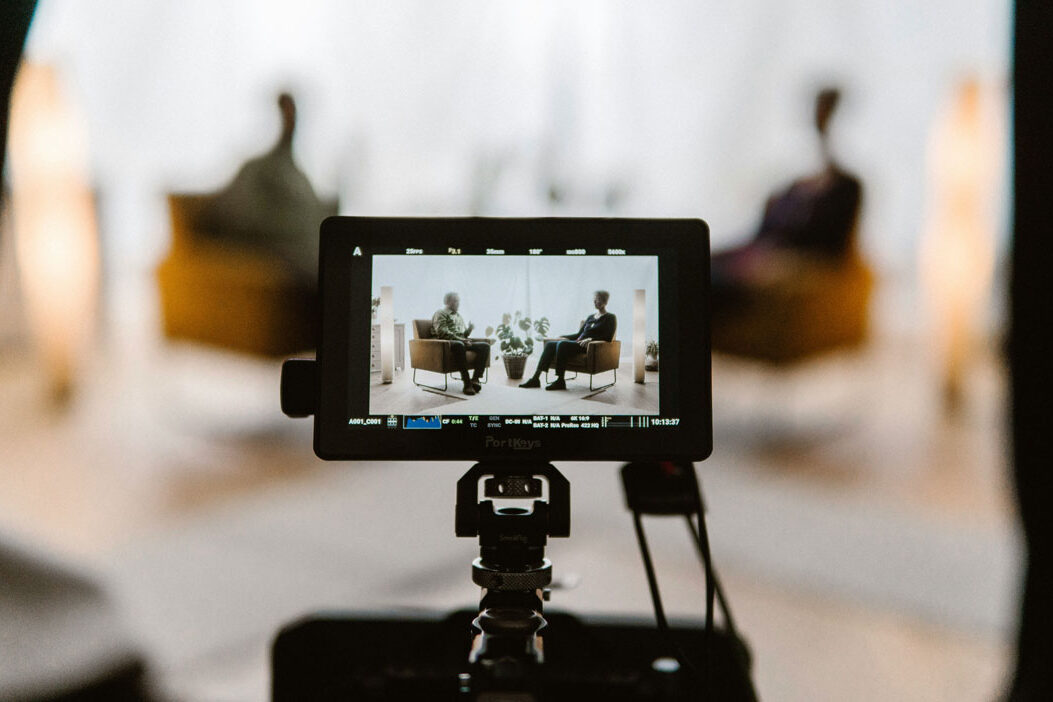
2. The number of cameras
A single-camera interview setup can work extremely well for many projects.
However, some productions benefit from using two cameras.
With two angles, the editor can cut between different perspectives and create a more dynamic finished film. It can also make it easier to remove pauses, mistakes or sections of an interview without every edit being visible.
A second camera can be particularly useful for:
- Founder stories
- CEO interviews
- Customer testimonials
- Case studies
- Documentary-style interviews
- Longer-form corporate films
You don’t necessarily need two cameras for every project.
The right question is whether the additional production value will benefit the finished video.
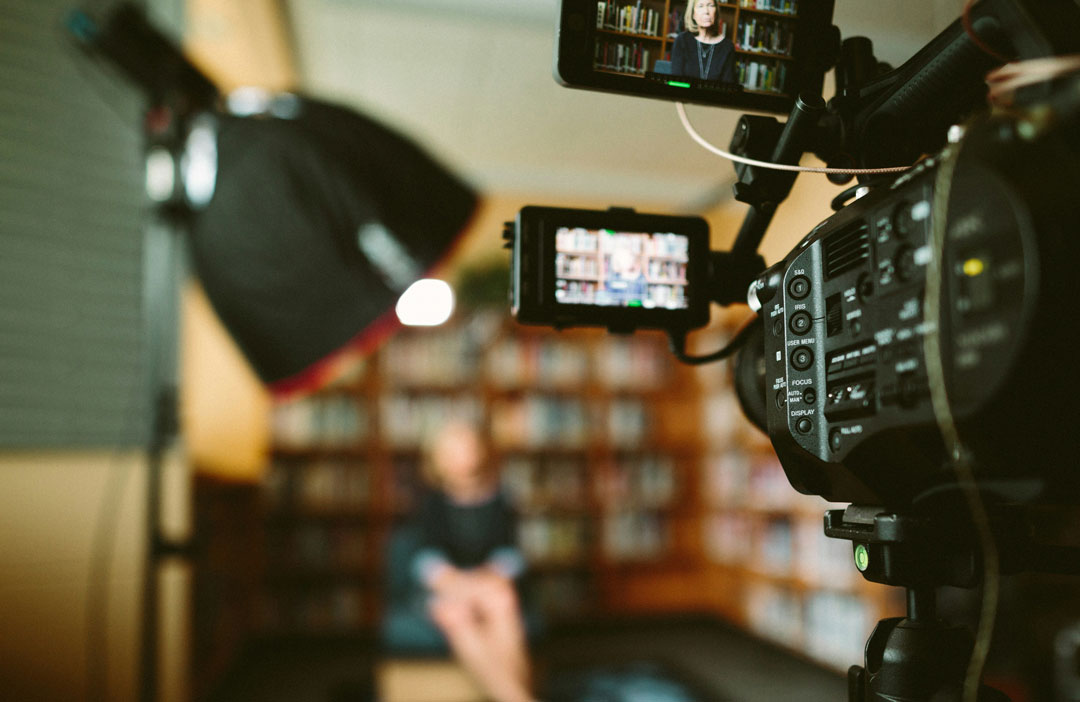
3. Professional lighting
Lighting is one of the things that can make a surprisingly big difference to an interview.
A professional interview isn’t simply a matter of putting someone in front of a window and pressing record.
The videographer needs to consider:
- The available natural light
- The position of the subject
- The background
- The time of day
- The room
- The visual style
- How the light works with the camera
Good lighting can make an interview feel polished, professional and consistent with your brand.
It’s particularly important if the finished video will appear prominently on your website or be used in sales and marketing campaigns.
4. Professional audio
If there’s one area where you shouldn’t cut corners, it’s sound.
People are surprisingly tolerant of an imperfect image.
They’re much less tolerant when they can’t clearly understand what someone is saying.
Professional interview production will normally involve dedicated microphones and audio recording rather than relying solely on the camera’s built-in microphone.
The videographer may also need to consider the acoustics of the location.
An apparently quiet office can contain plenty of unwanted sound:
- Air conditioning
- Traffic
- Computers
- Phones
- Other conversations
- Building work
- Echo
- Outside noise
Good interview audio should feel natural and unobtrusive.
You shouldn’t have to think about it while watching the finished film.
5. The location
Where you film can affect both the cost and the quality of the finished video.
An interview filmed in your office can often work extremely well.
It gives viewers some context about your business and provides opportunities for B-roll.
However, multiple locations can increase the production requirements.
You may need to consider:
- Travel time
- Parking
- Equipment transportation
- Additional setup time
- Location restrictions
- Permits
- Crew requirements
If you’re filming around London, even relatively short journeys can add time to a production schedule.
For that reason, it’s useful to decide whether additional locations genuinely add something to the story before including them in the brief.
6. The number of people being interviewed
One interviewee is very different from filming five people.
Every additional person can mean more:
- Setup time
- Interview time
- Lighting adjustments
- Audio checks
- Scheduling
- Editing
If you’re creating a company profile, for example, you might want to interview the founder, a member of the team and a customer.
That can create a much richer story, but it will also require more production time than a single interview.
7. B-roll
B-roll is the supporting footage that appears alongside the interview.
It might show:
- Your team working
- Your product being used
- Customers interacting with your business
- A founder walking through the office
- Meetings
- Your production process
- Your workspace
- A service being delivered
B-roll is one of the biggest differences between a simple talking-head video and a more story-driven corporate film.
Imagine a customer saying:
“Working with them completely changed the way we approached the project.”
You could simply show the customer saying it.
Or you could cut to footage of the team actually working together, the product being used and the result being delivered.
The second approach gives the viewer something to see, rather than simply something to hear.
If storytelling is important to your project, ask whether B-roll is included in your quote.
8. Interview direction and preparation
Not everyone is comfortable in front of a camera.
This is particularly true when you’re asking a CEO, founder, employee or customer to speak naturally about your business.
A good interview videographer can help with this.
Preparation might include:
- Discussing the purpose of the video
- Planning interview questions
- Helping the interviewee understand what to expect
- Creating a relaxed environment
- Asking follow-up questions
- Encouraging more natural answers
- Helping the subject stay focused
This can have a huge effect on the final result.
A technically perfect interview isn’t particularly useful if the person on camera sounds like they’re reading a corporate press release.
What should be included in an interview videography quote?
When comparing London videographers, ask exactly what is included.
A professional interview production might include:
1. Pre-production
- Initial consultation
- Project planning
- Interview preparation
- Location advice
- Scheduling
- Creative planning
2. Filming
- Professional cameras
- Lighting
- Professional audio
- Interview direction
- Camera operation
- B-roll
- Crew
3. Post-production
- Video editing
- Colour grading
- Audio mixing
- Music
- Graphics
- Captions
- Revisions
- Final exports
Not every videographer will include all of these.
Some may offer them as additional options.
That’s why it’s important to compare the complete scope of the project, rather than simply comparing the headline price.
How much does editing add to the cost?
Editing is often one of the biggest parts of a video production budget.
An interview might only take a few hours to film, but the editor could spend considerably longer reviewing the footage and shaping it into a coherent story.
A professional edit may involve:
- Reviewing all recorded footage
- Selecting the strongest answers
- Structuring the story
- Removing repetition and mistakes
- Selecting B-roll
- Editing music
- Mixing the audio
- Colour grading
- Adding graphics
- Creating captions
- Exporting different versions
- Making revisions
This is why comparing videographers based purely on their day rate can be misleading.
A lower filming rate doesn’t necessarily mean a lower overall project cost if editing is charged separately.
Before booking, ask whether you’re receiving a complete production quote or simply a filming rate.
Should you hire a freelance videographer or a production company?
This is another factor that can affect the cost.
A freelance videographer may be the right choice for a relatively straightforward project.
A production company may make more sense if your project requires:
- Multiple crew members
- Multiple cameras
- More extensive lighting
- Complex production
- Several locations
- Detailed pre-production
- More involved post-production
Neither option is automatically better.
The important thing is matching the production setup to the project.
For a simple interview, you may not need a large crew.
For a major customer case study or flagship brand film, additional production support could be worthwhile.
Is a more expensive videographer always better?
No.
A higher price doesn’t automatically mean a better video.
Likewise, the cheapest quote isn’t necessarily the best value.
When comparing videographers, look at:
Portfolio + experience + production quality + process + deliverables + communication + price.
Ask yourself whether they understand the purpose behind your video.
For example, a founder video designed to build trust with potential customers requires a different approach from an internal training interview.
A customer case study needs a different story structure from a recruitment video.
The best videographer for your project is one who understands that difference.
How much should you spend on an interview video?
A useful starting point is to work backwards from the outcome.
1. If you need a straightforward interview
You may not need a large production.
A professional camera, lighting, audio and a well-edited final video could be enough.
2. If you need a customer testimonial
Allow enough time for both the interview and supporting B-roll.
The customer’s story will generally be much more convincing when viewers can see the product, service or people they’re talking about.
3. If you need a founder or CEO film
Consider investing more heavily in production quality.
A leadership video isn’t just another piece of content.
It’s representing the person and the company behind the brand.
4. If you need a case study
Allow time for the story to develop.
The problem → what happened → the solution → the result.
That often requires more than simply recording a few answers.
5. If you need social content
Plan for it before the filming day.
The interview questions, framing, composition and filming approach can all be designed around creating multiple usable clips.
How to get better ROI from an interview shoot in 2027
One of the biggest mistakes businesses make is deciding what the video should look like before deciding what the video needs to do.
Before you book a videographer, think about where the content will be used.
For example:
- Your website
- YouTube
- Sales presentations
- Recruitment
- Email marketing
- Paid advertising
- Social media
- Internal communications
Once you know this, you can plan the production accordingly.
One well-planned interview could potentially become:
**One main film
- short-form videos
- vertical clips
- social content
- website content
- sales material**
The exact number of assets will depend on the project, but the principle is simple:
Don’t just produce a video. Build a content asset.
This is particularly valuable for smaller businesses and marketing teams that need to get as much value as possible from every production day.
7 questions to ask an interview videographer before booking
Before accepting a quote, ask:
1. What’s included in the price?
Make sure you understand what is included for filming, editing, audio, lighting and revisions.
2. How many cameras will you use?
There isn’t a universally correct answer. Ask why the proposed setup is appropriate for your project.
3. How will you record the audio?
Professional interview audio should be part of the conversation from the beginning.
4. Will you help direct the interview?
This can make a huge difference if your interviewee isn’t experienced on camera.
5. Is B-roll included?
If you want a more engaging, story-driven video, find out whether supporting footage is part of the production.
6. How many final versions will I receive?
Ask about horizontal, vertical, short-form and social-media versions if you need them.
7. How does the revision process work?
Find out how feedback is handled and whether revisions are included in the quoted price.
What makes a good interview video worth paying for?
Ultimately, the value of an interview video isn’t determined by how many cameras were used or how long the filming day lasted.
It’s determined by what the finished video achieves.
A good interview video should:
- Communicate something clearly
- Make the subject feel credible
- Hold the viewer’s attention
- Feel authentic
- Look and sound professional
- Support your wider marketing goals
- Give you content you can actually use
The production should serve the story.
Not the other way around.
Interview videography in London
At Light Leak Productions, we take a story-first approach to interview filmmaking.
We work with businesses that need professional interview-led content, including founder stories, leadership interviews, customer testimonials, case studies and corporate videos.
Rather than treating an interview as simply a person sitting in front of a camera, we consider the wider story, from preparation and direction through to filming, editing and how the finished content can be used.
That might mean creating a polished interview for your website, a cinematic founder story, a customer case study or a collection of shorter videos from one well-planned shoot.
Explore our current video production packages → Price Guide
Or, if you’re not sure what level of production you need, get in touch and we can discuss the project with you.
Frequently Asked Questions
1. How much does a corporate interview video cost in London?
A professional corporate interview video can range from around £1,000 to several thousand pounds depending on the production requirements. Filming time, cameras, lighting, audio, B-roll, editing and the number of final deliverables can all affect the price.
2. How much does a 2-minute interview video cost?
The final running time doesn’t necessarily determine the production cost.
A two-minute video could require a short interview shoot and simple edit, or a much larger production involving multiple cameras, B-roll and extensive post-production.
It’s usually more useful to budget according to the complexity of the production rather than the final video length.
3. Do videographers charge by the day?
Some videographers use day rates, while others quote a complete project price.
A project quote can be easier to compare because it takes account of both production and post-production.
If you’re comparing day rates, make sure you also understand the cost of editing and other deliverables.
4. Does a corporate video include editing?
Not necessarily.
Always check the quote.
Some videographers separate filming and editing, while others offer complete production packages.
5. Do I need two cameras for an interview?
Not always.
A single-camera setup can work very well for a straightforward interview. Two cameras can provide more visual flexibility and make editing more dynamic, particularly for longer interviews, founder stories and case studies.
6. How long does it take to film an interview?
A simple interview can potentially be filmed in a few hours, while a larger production may require a full day or longer.
Remember to allow additional time for lighting, audio setup, interview preparation, B-roll and moving between locations.
7. Is B-roll important for an interview video?
It can be extremely valuable.
B-roll allows the editor to show the business, people, products or environment while the interview continues underneath. This can make the finished film feel considerably more engaging than a continuous talking-head shot.
8. Is it worth getting short videos from the same interview?
Often, yes.
If you’re already investing in professional filming, planning additional short-form content can help you get considerably more value from the shoot.
The key is to plan those outputs before filming rather than trying to create them as an afterthought.
Final thoughts
There is no single price for an interview videographer in London in 2027.
A straightforward interview might require a relatively modest production, while a cinematic founder story or detailed customer case study can involve considerably more planning, filming and post-production.
The best approach is to start with what you need the video to achieve.
Then work backwards.
What story do you need to tell?
Who needs to appear?
Where will you film?
How much supporting footage do you need?
Where will the final video be used?
How many pieces of content do you want?
Once you’ve answered those questions, it becomes much easier to establish a realistic budget and compare videographers on something more meaningful than price alone.
And ultimately, the best interview video isn’t necessarily the one with the biggest production budget.
It’s the one that tells the right story, looks and sounds professional, and gives your business something genuinely useful to use.
If you’re planning an interview video and want to talk through what’s right for your project, give us a shout, we’d be happy to help.